Web development
Sites, apps, and internal tools. We ship fast because AI does the scaffolding — you get clean code that your team can maintain.
- Marketing sites & landing pages
- Web apps & dashboards
- Internal tools & automations

Managed servers with audit logs, DPA, and EU AI Act compliance built in. Your agent keeps working while you sleep.
Three ways we help you build and run digital products in Europe.
We build and run your web apps, integrations, and internal tools. One team, idea to operation.
Explore servicesA managed EU server for Claude Code and AI agents. Always on, fully yours.
See hostingRisk checker, implementation guide, and compliance checklist. Free, no signup.
Open the toolsA managed EU server with compliance built in. You bring your API key — we handle the infrastructure, backups, and audit logs.
Your own dedicated VPS — one customer per machine, never shared.
Runs 24/7 in tmux. Your sessions keep going after you disconnect.
Run autonomous agents around the clock — no babysitting.
Automatic daily snapshots, 7 generations retained.
Hosted in Hetzner's Helsinki region, inside the EU.
A Data Processing Agreement comes with every plan.
Compliance controls built in from day one.
Network-level protection on every server.
Bring your own Anthropic API key — you keep billing control.
Full root access to your VPS.
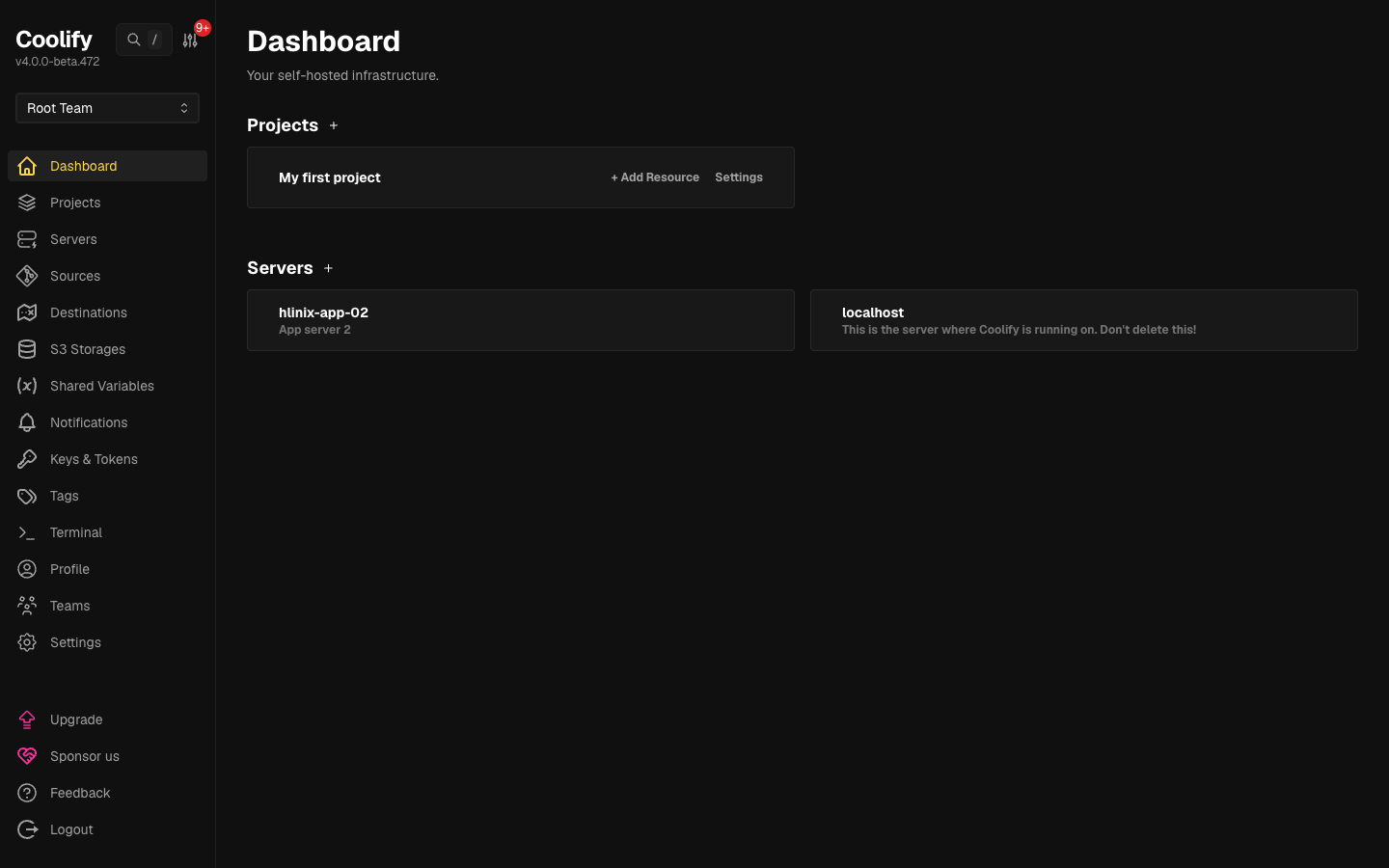
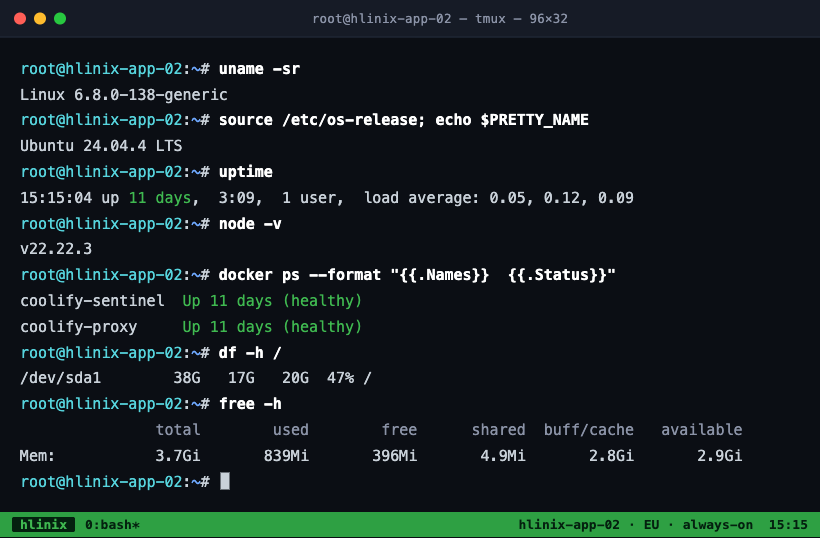
Compliance built in — audit-ready from day one, at no extra cost.
Every action recorded as structured, searchable logs.
Kept for full traceability, ready whenever you need it.
Complete separation — your own dedicated VPS, never shared.
Stored in Hetzner Helsinki. Never moved outside the EEA.
A GDPR-ready Data Processing Agreement, included with every plan.
1 AMD vCPU · 2 GB RAM · 40 GB NVMe · 20 TB transfer
For lightweight tasks and testing
Dashboard: +€10/mo add-on
Every plan includes:
2 AMD vCPU · 4 GB RAM · 80 GB NVMe · 20 TB transfer
Dashboard: +€10/mo add-on
Every plan includes:
4 AMD vCPU · 8 GB RAM · 160 GB NVMe · 20 TB transfer
Dashboard included
Every plan includes:
8 AMD vCPU · 16 GB RAM · 320 GB NVMe · 20 TB transfer
Dashboard included
Every plan includes:
All prices are net. VAT 23% applies.
Need an invoice or a custom plan? Contact us at hello@hlinix.com
Included on Pro and Max — a €10/mo add-on on Starter and Standard.
CPU, memory and disk usage in real time.
Git-connected deploys, one-click templates, and rollbacks.
PostgreSQL, MySQL, Redis and more.
Automatic certificate issuance and renewal.
Configure schedules and restore in a click.
Alerts via Email, Slack, Discord and Telegram.
Choose a plan and create your account.
Connect to your EU server with full root access.
Bring your own Anthropic API key.
Close your laptop. Claude Code keeps working in tmux.
Bring Your Own Key. You use your own Anthropic API key and pay Anthropic directly for model usage, keeping full control. We never touch your key's billing.
The full VPS — compute, storage, and 20 TB transfer — plus always-on tmux, daily backups, EU data residency, and support. You only add your own Anthropic API key.
Minutes. After sign-up you get SSH details right away — add your API key and start a session.
Yes. Plans are monthly with no lock-in. Cancel whenever you like; export your data first if you need to.
In Hetzner's Helsinki data center, inside the EU. A DPA is included with every plan.
No. You get full root on an isolated VPS. We provide the infrastructure and backups — access stays with you.
We build and run your web apps, integrations, and internal tools. One team, idea to operation.
Sites, apps, and internal tools. We ship fast because AI does the scaffolding — you get clean code that your team can maintain.
Your CRM talks to your invoicing but not to your warehouse. We connect the pieces so data flows without manual steps.
We don't hand off and disappear. Hosting, monitoring, and updates — your system stays our problem.
Automation that replaces the tasks you keep postponing. Document processing, workflow bots, and assistants that actually get used.
A simple path from idea to a running system.
You tell us what's broken or missing. We figure out if we can fix it.
Fixed scope, fixed price. No surprises halfway through.
We build in short cycles. You see working software, not slide decks.
We deploy, monitor, and pick up the phone when something breaks.
No subcontractors, no handoffs. You talk to the people who write the code and run the servers.
We use Claude Code and AI tooling in every project. You get more done for the same budget.
Clean code, documented systems, and someone to call when it needs updating.
Everything you need to understand your obligations: a risk checker, a full implementation guide, and a compliance checklist. Free, no signup.
Answer 7 questions to see your risk classification and legal obligations. About 2 minutes.
15 chapters, from risk classification to enforcement. Written for deployers, not lawyers.
Plain-English articles and a 10-step compliance checklist — from the transparency rules already in force to the high-risk obligations arriving in December 2027.
These tools are published in English.
Questions about a project, hosting, or compliance? We'd love to hear from you.
Email us:
hello@hlinix.com